
New Jersey has become one of the nation's strongest community solar markets. Strong electricity demand, a mature statewide program, and supportive policy continue to create attractive opportunities for commercial property owners.
Because community solar projects typically take 14–32 months from initial site evaluation to commercial operation, property owners who start evaluating opportunities early have more flexibility to maximize long-term project value.
Planning Ahead for New Jersey's Community Solar Program
The New Jersey Community Solar Energy Program became permanent in 2023, and registration for an additional 3,000 MW of community solar projects opened in March 2026. Registration remains open through December 2029, or until all available program allocations are claimed.
Projects registered earlier lock in the incentive rates available at the time of registration, while future projects may qualify under lower incentive levels as the program matures — making development timing an important factor in project economics.
Key Takeaways
- New Jersey's permanent Community Solar Energy Program creates a long-term market for qualifying commercial rooftops and land.
- Property economics depend heavily on utility territory, interconnection feasibility, roof condition, and site characteristics.
- Host structures can generate long-term lease income without requiring property owners to invest capital or operate the solar system.
- Because development timelines extend well beyond a year, assess site feasibility and interconnection before pursuing lease terms.
How the Community Solar Host Model Works
Community solar allows commercial property owners to generate income from underutilized rooftops or land without owning or operating a solar system.
Under a typical host lease structure, a solar developer finances, designs, builds, owns, and operates the project at no cost to the property owner. The electricity generated is delivered to the grid, and subscribers receive credits on their utility bills based on their share of the system's output.
In exchange for hosting the project, the property owner receives long-term lease payments, typically structured over a 20-year term. The developer manages subscriber enrollment, billing, maintenance, and ongoing operations.
For REITs and portfolio owners, the model is particularly straightforward. Because the developer owns the system, they capture available tax incentives and assume operational responsibility, while the host receives a predictable income stream with no capital investment required.
What Your Property Could Earn — And What Determines It
For commercial property owners, the financial case is simple: lease your rooftop or land to a qualified solar developer, collect predictable income for 20 years, and put no capital at risk.
Based on current New Jersey market conditions, property owners hosting community solar projects can expect average annual lease earnings of approximately $80,000 — translating to roughly $1.6 million in cumulative income over a standard 20-year term, with annual escalators of 1–2% built into most agreements.
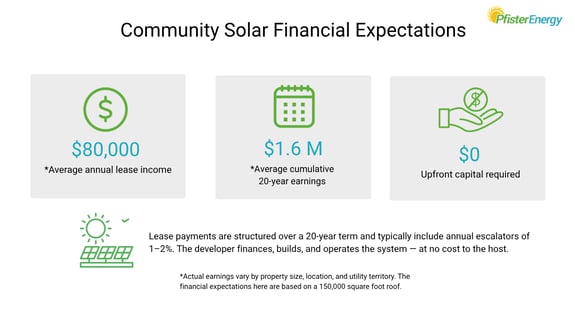
Figure 1. Illustrative 20-year community solar host economics for a qualifying 150,000-square-foot commercial roof in New Jersey.
What determines where your property lands relative to that average comes down to four factors.
1. Roof condition and useful life. A system installed today is expected to operate for 20+ years. Developers will require confidence that the underlying roof can support that lifespan. Buildings with roofs nearing the end of life may need remediation before or alongside installation, affecting the timeline and net economics. Significant shading from HVAC equipment, parapets, or adjacent structures also reduces usable capacity. Roof condition and age are among the first things a credible site evaluation will assess.
2. Utility territory. New Jersey's four participating utility service areas—PSE&G, JCP&L, ACE, and RECO—each has different subscriber market dynamics and interconnection pathways. PSE&G territory, covering northern and central New Jersey, offers the deepest subscriber pool but historically the tightest grid capacity. ACE territory in southern New Jersey has marginally stronger solar resources and, in some cases, more favorable interconnection conditions. JCP&L community solar and RECO territories have their own distinct dynamics. Where your property sits affects both the market depth a developer can tap and how quickly a project can reach commercial operation.
3. Grid access and interconnection feasibility. A building with strong physical characteristics can face significant cost increases or timeline delays if the nearest interconnection point lacks sufficient hosting capacity. You can't assess interconnection feasibility without a formal study—a core part of any serious site evaluation. It is one of the variables that most often separates a viable project from one that looks good on paper.
4. Existing encumbrances. Roof or ground leases, easements, deed restrictions, or zoning classifications that limit energy development use all require review before a community solar lease can be structured. These are rarely dealbreakers, but it's better to surface them early than discover them mid-negotiation.
Those four factors determine where your property lands relative to the $80,000 annual average. A detailed site evaluation is typically required to assess revenue potential, interconnection feasibility, and project viability.
New Jersey's Regulatory Landscape — What Hosts Need to Know
New Jersey's community solar framework has expanded significantly over the past three years and continues to evolve. Understanding its key elements directly affects project timelines, lease economics, and the value of moving forward now rather than later.
-
Permanent community solar program. The New Jersey Board of Public Utilities administers the Community Solar Energy Program, approves projects, sets incentive levels, and oversees interconnection across all four participating utilities. The program became permanent in August 2023, replacing a two-year pilot that demonstrated strong demand and subscriber uptake. Individual projects are capped at 5 MW.
-
The 3,000 MW expansion. In August 2025, Governor Murphy signed S4530 into law, directing the BPU to open registration for an additional 3,000 megawatts of community solar capacity — roughly four times the amount built or allocated under the permanent program to that point. Registration opened in March 2026 and remains open through December 2029, or until the full 3,000 MW is registered, whichever comes first. The law also removed the prior 150 MW annual registration cap, enabling large-scale deployment at a pace the earlier framework couldn't accommodate.
-
Consolidated billing. New Jersey implemented consolidated billing as part of the 2023 permanent program legislation, streamlining the subscriber experience by combining the bill credit and subscription charge on a single utility statement. This reduces enrollment friction and subscriber attrition — both of which directly affect how quickly a project reaches full subscription and how stable that subscription base remains over the life of the project.
-
Successor Solar Incentive (SuSI).
Developers earn production-based incentives through New Jersey's Successor Solar Incentive (SuSI) program, an important component of overall project economics. Incentive levels have begun to decline as the program matures, which may affect the economics available to projects registering in future periods.
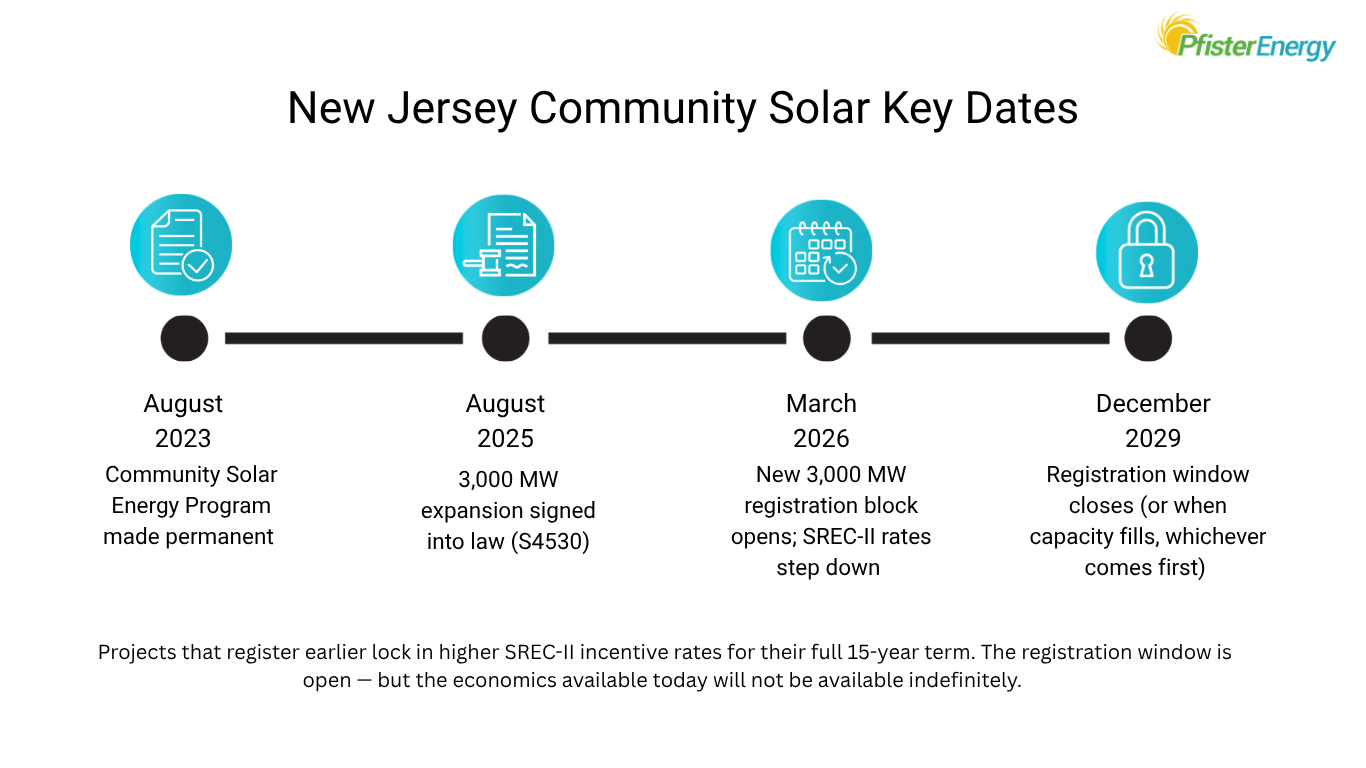
Figure 2. Key New Jersey community solar regulatory milestones, including the permanent Community Solar Energy Program, the 3,000 MW program expansion, registration window timing, and Successor Solar Incentive (SuSI) program developments that influence project economics and host lease values.
Developer Perspective
"Every community solar project is unique, but one trend remains consistent: evaluating a property's development potential early provides owners with more options. Site suitability, interconnection availability, roof condition, and lease structure all take time to assess, and those factors are easier to address before market conditions become more competitive," said Wayne Pfisterer, CEO of Pfister Energy.
What the 51% LMI Requirement Means for Your Property
New Jersey requires every community solar project to allocate at least 51% of its capacity to low- and moderate-income (LMI) subscribers, who must receive a guaranteed bill credit discount of at least 20% relative to their standard utility rate. The developer is entirely responsible for meeting that requirement — not the host.
But LMI subscriber recruitment is consistently slower and more operationally demanding than market-rate recruitment, and a project that struggles to reach full subscription delays the stable lease income a host is counting on. How well a developer manages their LMI pipeline is a legitimate due diligence question — and one that plays out very differently depending on where your property sits.
New Jersey's four utility territories present an uneven LMI landscape. PSE&G territory, covering the state's densest urban corridor, has the deepest LMI subscriber pool in the state — but also the tightest grid capacity and the most competitive development environment. ACE territory in southern New Jersey has stronger grid hosting capacity and more available development sites, but a thinner, more geographically dispersed LMI population, meaning developers operating there need an established, low-density recruitment infrastructure to reliably hit the 51% threshold on schedule. JCP&L community solar projects present their own subscriber dynamics, with LMI pool depth varying by location, while RECO's smaller service territory warrants individual assessment.
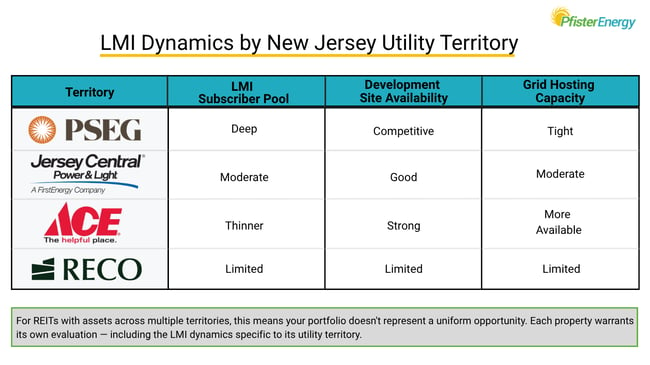
Figure 3. Comparison of New Jersey utility territories based on low- and moderate-income (LMI) subscriber availability, development opportunities, and interconnection conditions across PSE&G, JCP&L, Atlantic City Electric (ACE), and Rockland Electric (RECO).
Five Things to Evaluate Before Signing a Community Solar Lease
The largest risks in community solar are rarely technical. They are development and execution risks — interconnection feasibility, project timelines, subscriber acquisition, and lease structure — that ultimately determine whether a project delivers on its expected economics. Evaluating these five areas before committing will improve the project's long-term ROI and success.
1. Confirm interconnection feasibility before committing to a lease. Lease terms are only as good as the project's ability to get built. A developer who moves quickly to secure a host site before completing a preliminary interconnection assessment may be prioritizing pipeline over execution. In New Jersey, where grid hosting capacity varies significantly by territory, and prior registration blocks have filled quickly in some areas, interconnection feasibility should precede any lease commitment.
2. Understand the development timeline — and its implications. A realistic path from initial site assessment to commercial operation runs 14 to 32 months, varying significantly based on utility territory, interconnection requirements, permitting complexity, and project size. While program rules generally require projects to reach permission to operate within 18 months of conditional registration — or 24 months for landfill or contaminated-site projects, with a possible six-month extension — the full process often begins earlier with site review, lease negotiation, interconnection analysis, permitting, and financing. Ask any prospective developer for a realistic timeline specific to your site and territory — not a best-case projection.
3. Discuss your developer's approach to LMI subscriber recruitment. LMI recruitment is more operationally demanding than market-rate recruitment, and a developer's capability in your specific utility territory is worth exploring before you sign. Ask how they source LMI subscribers, what their current subscription rates look like across their portfolio, and what community partnerships support their outreach.
4. Plan for roof remediation before solar installation. A roof requiring replacement mid-lease creates costly complications for both parties. Assess roof condition and useful life relative to a 20-year lease term before, not after installation. A credible developer will raise this proactively in the site evaluation process.
5. Look for escalator provisions, clear lease terms, and a proven track record. A flat lease payment over 20 years loses meaningful value to inflation, so most well-structured agreements include annual escalators of 1–2%. It's also worth reviewing how the agreement handles maintenance responsibilities, roof access, and end-of-term obligations. Because community solar leases often extend for 20 years or more, property owners should also understand who stands behind the project and whether the developer has the financial strength and operating history to support long-term performance.
New Jersey's Community Solar Opportunity
New Jersey's community solar market has moved beyond the pilot stage and into long-term program maturity. The state's recent 3,000 MW expansion reflects a clear commitment to continued growth, creating meaningful opportunities for commercial property owners with suitable rooftops and land.
At the same time, project economics are evolving. Community solar incentives have already declined from $80/MWh to $60/MWh, demonstrating that the economics available to future projects may differ from those available today.
The opportunity is expected to remain available for years. Today's project economics may not.
Next Steps for Property Owners
The first step isn't committing to a project—it's understanding your options. A site assessment can help determine development potential, estimated lease revenue, interconnection considerations, and project timing so you can make an informed decision with confidence.
Explore our Community Solar services or contact Pfister Energy to discuss whether your property may be a candidate for development.